
Photo by Charles University, Hynek Glos
The colonial legacies of universities
ERC Horizon Europe Program, EU
Universities and science in Europe experienced significant growth during the colonial period, evident in controversial buildings, collections, and botanic gardens. How can we make narratives about scientific progress more inclusive, honoring local voices and perspectives?
Photo by Charles University, Hynek Glos
Decolonising knowledge
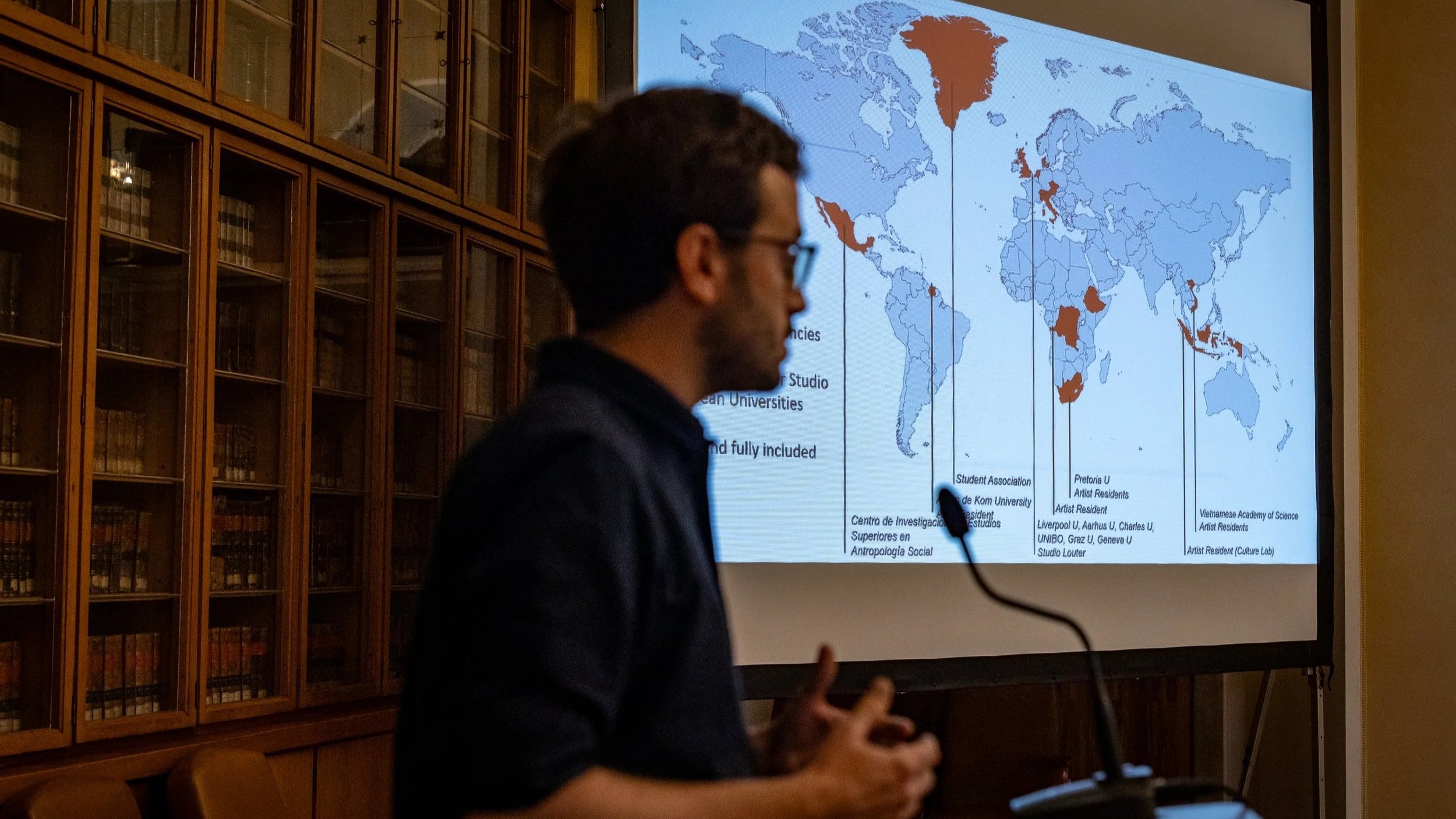
The international project “Colonial Legacies of Universities: Materialities and New Collaborations” (COLUMN) sheds new light on the colonial backgrounds and material legacies of knowledge production. In today’s increasingly globalised scientific landscape, universities in Asia, Africa, and South America play a crucial role in redefining knowledge. Equitable collaboration with researchers and curators from former colonies such as Suriname, South Africa, Vietnam, Indonesia, and Mexico is therefore an essential part of this project.
In the Subtropical Greenhouse of the Botanic Garden, you can find, among other plants, the 'Cape crop' Angel's Trumpet (Brugmansia spp.)
Botanic Gardens as colonial heritage sites
Botanic gardens have a history deeply intertwined with European colonialism. They serve as significant centres of knowledge and as places where nature was collected and cultivated. Together with Utrecht University, the University of Bologna, and the University of Suriname, Studio Louter is developing innovative educational programmes that encourage critical reflection on the complex intersections of science, nature, and colonialism.
Photo exhibition on colonial university heritage at the Pusaka Museum in Nias.
Photo by Gertjan Plets
Collection of Plaster Casts
What does a collection of plaster face casts—from Lidio Cipriani's collection from South Africa (UNIBO) and the Pavel Šebesta collection from The Congo (CU)—tell us about their often controversial history? Together with Utrecht University, the University of Bologna, the University of Pretoria, and Charles University in Prague, we are creating an intervention that not only highlights the contested history of plaster casts but also invites to reflect on their role and significance in the future. The exhibition underscores the importance of provenance research and explores local perspectives.
“International collaboration is essential to decolonize scientific heritage and ultimately transform the university.”
Gertjan Plets, project leader and associate professor, Utrecht University 一 December 2024
Credits
Client
ERC Horizon Europe Program
Swiss National Science Foundation (SERI)Content Design
Studio LouterIn Collaboration with
Universiteit Utrecht,
Universitaet Graz,
Univerzita Karlova,
Aarhus Universitet,
Universita di Bologna,
University of Pretoria,
Anton de Kom Universiteit van Suriname